This is a limited public summary. Login to Booksu to learn more from this book using interactive features like AI Chat, Audio Summary, Key Takeways and more.
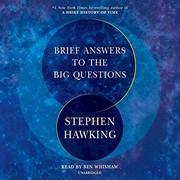
In "Brief Answers to the Big Questions," Stephen Hawking tackles some of the most profound questions facing humanity and science today. The book distills complex scientific ideas into accessible explanations, aiming to inspire curiosity and understanding.
Hawking explores topics ranging from the existence of God and the origins of the universe to the future of artificial intelligence and space exploration. His insights are grounded in decades of research and a passion for uncovering the mysteries of the cosmos.
The book also reflects on humanity's role in the universe and the challenges we face, including climate change and technological advancement. Hawking's clear, engaging prose invites readers to contemplate the big questions that shape our understanding of existence.
1
Explores fundamental questions about the universe and humanity's place within it.
2
Discusses the origins of the universe, including the Big Bang and black holes.
3
Examines the potential and risks of artificial intelligence.
4
Considers the future of space exploration and colonization.
5
Addresses climate change and the survival of humanity.
6
Reflects on the relationship between science and religion.
7
Encourages scientific curiosity and critical thinking.
Chapter 1: Introduction
Hawking introduces the purpose of the book and the importance of addressing big questions.
Chapter 2: Is There a God?
Explores the relationship between science and religion, and the concept of a creator.
Chapter 3: How Did It All Begin?
Discusses the origins of the universe, including the Big Bang theory.
Chapter 4: Is There Other Intelligent Life in the Universe?
Considers the possibility of extraterrestrial life and its implications.
Chapter 5: Can We Predict the Future?
Examines the limits of prediction in physics and cosmology.
Chapter 6: What Is Inside a Black Hole?
Explains black holes and their significance in understanding the universe.
Chapter 7: Is Time Travel Possible?
Explores theories and possibilities related to time travel.
Chapter 8: Will We Survive on Earth?
Addresses environmental challenges and humanity's future on the planet.
Chapter 9: Should We Colonize Space?
Discusses the necessity and challenges of space colonization.
Chapter 10: Will Artificial Intelligence Outsmart Us?
Analyzes the potential benefits and risks of AI development.
Chapter 11: How Do We Shape the Future?
Encourages proactive engagement with science and technology to influence our destiny.
Chapter 12: Conclusion
Summarizes key insights and inspires readers to continue exploring big questions.
Chapter Breakdown
Get AI-generated chapter summaries and detailed breakdowns
Listen to a free AI-generated audio summary of this book and others
Key Takeaways
Understanding the universe requires both scientific inquiry and imagination.
Artificial intelligence holds great promise but must be managed responsibly.
Space colonization may be essential for humanity's long-term survival.
Climate change is an urgent threat that demands immediate action.
Science and religion address different questions and can coexist.
Curiosity and perseverance drive scientific progress.
Everyone can contribute to solving big questions through education and innovation.
Unlock awesome features of Booksu
Register to enjoy
Detailed Explanations
Get in-depth explanations for each takeaway with examples and actionable steps
Understand Books with AI
Ask questions and discuss your books with our intelligent AI assistant
Personalized Library
Personalized book recommendations, save books, and organize your favorites
Audio Summaries
Listen to key takeaways of your book with audio book summaries
About the Author
Stephen Hawking was a renowned theoretical physicist and cosmologist, celebrated for his work on black holes and the nature of the universe.
Despite being diagnosed with ALS at a young age, he made groundbreaking contributions to science and became a bestselling author. Hawking was also a passionate advocate for science education and public understanding.
His ability to communicate complex ideas to a broad audience made him one of the most influential scientists of his time. Hawking's legacy continues to inspire curiosity and exploration.
Welcome Back
Sign in to access your personalized library and AI features
Join Booksu
Create your account to unlock AI-powered book summaries